Showing posts with label India. Show all posts

Friday, December 30, 2016

Pax Indica

While demonetization, the sabre-rattling between India and Pakistan and the rancor filled  spat between India’s current political Goliath – Narendra Modi - and the Gandhi family scion – Rahul Gandhi – oft derided as `Pappu’ in social media, may have been what hogged headlines through the year, a little noticed statistical change underlined a trend that has been going in India’s favour  for the last several decades now.

India’s economy pipped that of its former colonial master Britain on the back of a  spectacular growth story spanning two-and-a-half decades and a drastic fall in the value of the British Pound after a vote in the island nation to exit from the European Union.


This makes India the 6th richest nation in terms of nominal Gross  Domestic Product or GDP, just behind France, though in terms of per capita income, the Asian giant remains at a lowly 149th .  In terms of GDP calculated using a complicated purchasing power parity formula which takes into account how much a dollar buys in a particular country, India is already the third richest nation after the US and China.

A 20 % decline in the value of the Great Britain pound through 2016, saw the former colonial power’s GDP slipping to $ 2.29 trillion, compared to India’s $ 2.30 trillion.  This gap is however expected to widen as India grows at between 6 – 7 % per year compared to Britain’s 2-3 % annual growth.

India was supposed to surpass Britain’s economy by 2020. However the quicker overtake by the former colony happened partly because she grew faster over the last decade or so and partly because of Britain’s own economic woes.

This marks an milestone of sorts for India’s economy which went into a decline after the British invaded the sub-continental nation taking advantage of India’s political disunity after the decline of the Mughal empire.

India in the 18th century produced 22.5 % of the globe’s GDP. In contrast in the same era, Britain accounted for just 1.8 % of world GDP. By 1820, when the British had more or less conquered most of India, the sub-continent’s share of the world economy had started declining and accounted for 16 % of world GDP.

Colonial rule turned India into a market for Britain’s industrial revolution as compared to a net exporter of spices, silks, cotton textiles and luxury goods. At the same time, high taxes which an arrogant  East India Company and afterwards British Queen  imposed on its conquered people  helped transfer India’s silver stock to the wind-swept, previously impoverished British Isles.

History has had many milestones which underline or accentuate a trend. India’s defeat at the hands of the British at Plassey in 1757, is widely considered a symbol of India’s and Asia’s fall from power. Similarly, Japan’s victory over Russia in 1905 is seen as marking the resurgence of Asia, giving revolutionaries in India and China confidence to fight to shake off their respective colonial shackles.

While the US victory in World War II  was seen as the beginning of the end of European dominance and the start of a bi-polar world, where besides the power which the USA emanated and used, America’s icons – jeans, pop music and Coca-Cola along with Hollywood movies - became pan-global symbols.

It may not be correct to place India’s upsetting Britain in the economic rankings at par with these epoch making events,  however, it does mark a trend.

Since 1947, when India won her freedom, economic growth grew at a leisurely 3.5 % annually, dubbed by the economist KN Raj as the `Hindu rate of growth',  as the country tried to cope with the aftermath of partition with its mass migration of millions of people; several wars; an unprecedented refugee crisis triggered by Pakistan’s 1971 civil war; natural calamities;  even as it built up an infrastructure for steel-making and machinery manufacture, harnessed its turbulent rivers to produce hydro-electric power, built colleges to produce one of the largest army of  scientists and engineers.


In the 1980s, a spate of trade and currency reforms ushered in under the tutelage of Pranab Mukherjee, then finance minister quickened the pace of growth to over 5 % for the first time. A burst of reforms which unshackled the economy  in the 1990s, curated by Dr Manmohan Singh saw growth leap to beyond 6 %. Through the last two-and-a-half decades the average GDP growth has averaged between 6-8 % annually, helping India turn into a two trillion dollar plus economy.

India’s ability to win a spectacular military victory in 1971, in just 14 days liberating Bangladesh, a nation the size of Greece, its ability to test a nuclear bomb in 1974 and launch a satellite in the very next year had marked India’s arrival in the global power stage. However, its image as a poor, third world nation with its crowd of motely beggars and snake-charmers and streets where elephants and camels still roamed persisted for decades afterwards.

By the late 1990s, by when the impact of India’s Perestroika were visible and by when the nation had been hailed as the software factory of the world, that image started changing. The overtaking of Britain, its former colonial master, was in a sense a continuation of the new narrative that India had started building for itself.

Psychologically, India overtaking Britain in the GDP rankings underlines an emerging trend, which acknowledges India’s arrival at the head of the table and marks a sea- change in relations’ between a former colony and the rest of the world.

British Prime Minister Theresa May at an Indian temple


This economic strength acquired over decades is what gave  India the ability to tell off British Prime Minister Theresa May when she refused to relent on the tough visa norms her government has adopted against Indians, while seeking a free trade deal with the Asian powerhouse. The new `Iron Lady’ had to fly back to London without a deal. 

However, before our rulers of the day pat themselves on the back and lay claim to this milestone, let us be very clear that the credit for this goes to the hard work put in daily by more than a billion ordinary Indians and their sacrifice of saving nearly a third of their incomes for the betterment of future generations, despite the glitter of consumerism unfolding before their eyes.


Our leaders need rather to remember that India still has a long path to traverse as it strives not only to feed, educate and keep healthy a huge population but to increase their average wealth at a fast pace so that they enjoy the benefits of a standard of living nearer  to that of the first world citizens.

Tuesday, November 15, 2016

Demonetisation Hiccups

The New Mysore Printed Notes
Mysore’s bank note printing line is of recent vintage, though the press has been around for several decades.  Despite its limited capacity to churn out notes, the Narendra Modi Government decided to use it to churn out the new Rs 2,000 and Rs 500 notes as it was supposed to be one of the most secured printing locations, manned by staff who could be counted upon to keep a secret. Next to it was a security note manufacturing plant set up in collaboration with the European security printing giant De La Rue.

The historical town also had a small, sleepy airport which could be used to fly aircraft to ferry the notes to major centres where RBI had currency chests. However, this need to keep secrecy mean that only 48 crore Rs 2000 notes and an equal number of Rs 500 notes could be manufactured and printed in the four to five months that led up to the sudden demonetisation of the money.

The total value of the new notes printed being just Rs 120,000 crore. The problem that the Government faced was that when it demonetised all Rs 500 and Rs 1000 notes, it sucked out some 86 % of all money in circulation in the country. With some 16 lakh crore rupees worth of money in circulation, this meant that 13.76 lakh crore rupees was being sucked out.

The replacement money was just not in place to take care of the huge demand.

Till now banks have been able to dispense just about Rs 50,000 crore worth of money.  Except a few top officials in North Block, the prime minster,  the finance minister and home minister, as well as the RBI Governor, very few officials were kept in the loop.

Officials who were in the know seemed to have been in a hurry to get the scheme going instead of taking stock of the logistics which needed to be worked out for such a huge operation. Hopefully in the weeks ahead things will improve as more security presses including Bengal’s Salboni are pressed into action.

The secrecy again meant that not too large a stash of extra Rs 100 notes could be printed and kept in storage. Added to that was the imperative of another decision prompted by intelligence inputs that Rs 100 notes too had been counterfeited by the secret service of a neighbouring country. “It has been decided in principle to replace all notes in  a gradual manner,” said officials. Some 6-7 % of all Indian notes in circulation are believed to be counterfeit, and this was probably the driving reason for the note replacement excercise. 

For the ordinary citizen of course to the `pain’ of sudden demonetisation, was the added discomfort of non-functional automatic teller machines. Again secrecy meant banks were not told to recaliberate ATMs which dish out notes to recognise the new notes.

All ATMs in India need to be calibrated afresh to recognise the new notes by  their weight, dimensions, design, and security features. Bankers say this could take over a month to complete as some 2 lakh ATMs will have to be worked on. Finance Ministry is working to a deadline of 3 weeks.

The recaliberation, Which would involve readjusting the cash trays, or cassettes, and the software running the machines, has to be done by technicians and takes about 4 man hours of work on each ATM. This translates to some 8 lakh man hours of work. With security cleared technicians in short supply, this means long work hours and the possibility of the 3 week deadline being missed, admit officials.


Till then, as consumers of money, citizens will have to grin and bear the “pain”. 

Monday, August 8, 2016

The GST Fire


An exhibition of tanks by DRDO coincided with
the passage of the GST BIll in Rajya Sabha

The Goods & Services Tax which India has voted to bring in from April next year,  may while uniting the fragmented Indian market to the delight of India Inc., also exacerbate that `Elephant in the Room’ which the country’s economy has been grappling with for decades now – Inflation.
Global experience has shown that GST brings in its wake a rise in prices all around for at least a year before, prices settle down and even decline. Knowing India, and the way our businesses work, one cannot doubt that it would indeed be a small miracle if prices come down after rising. India Inc., is obviously happy with the tax as it means a uniform tax regime all over the country and an end to the hassles of delayed shipments due to Octroi queues at state borders. However, those who will have to bear the burden of the tax may not be as happy despite the news media trumpeting how the tax structure will make India more competitive.
That dreaded word which every retiree living on a fixed income and every salary earner whose increment is slower than the rate of price rise fears, is inflation. Will this fear which if and when proven true,  turn voter ire into a raging resentment around the time of the 2019 General Election ?
Are we already paying too high a price ?

Malaysia which adopted GST in 2015, saw an increase in retail inflation despite careful planning and leaving out many essential products from the taxation altogether. Australia’s John Howard Government almost lost the general elections after bringing in GST.
Canadian Conservative Prime Minister Kim Campbell actually lost the 1993 elections after the electorate protested price spikes induced by her predecessor Brian Mulroney introduction of the GST.   The Indian example is nearest to Canada with its two stage GST rate – one levied by the state and one by the Centre.
The Congress while demanding a cap on the nation-wide GST tax’s median rate, is possibly taking a leaf out of economic history and trying to position itself for the next General Elections, when it may well look to channel protests against  the initial bout of inflation which GST may usher in.
Former Finance Minister P Chidambaram has already made it clear that the Congress will campaign throughout the country demanding a low GST median rate. In case, (and it looks like they will), the Government chooses a higher median rate  and an even higher rate for luxury and sin goods, rest assured the Congress and other political parties who would include the BJP’s own allies, will lose no time in pillorying the ruling  party for its folly in unleashing the Inflationary monster.   
Goldman Sachs in a research note found that Asian countries which brought in GST between 1977 and 2015, all reported an average increase in inflation of 1.1 %  higher on average in the year of its implementation. Sachs also estimated, based on cross-country evidence and the evidence from state VAT implementation, that retail inflation in India could rise 0.9 percentage points if the GST rate were to be 20 per cent.
With retail food inflation having built up over the years, any further increase in inflation is likely to prove to be an incremental burden on the populace. Consumer price index was just shy of the 6% mark in June. Even more worryingly, Retail inflation in rural areas has consistently outpaced urban areas in the past 18 months, hitting 6.20 per cent in June, well above 5.26 per cent in cities such as Mumbai.
Reserve Bank of India Governor Raghuram Rajan’s harsh inflation targeting, which often led him to refuse to bow down to pressures to ease interest rates had put him at odds with successive finance ministers looking to pep up Indian growth suffering from a global industrial slowdown.
As a response to that `Nay-saying ' by Rajan, a new mechanism which the Government is ushering in may give the Finance Ministry a larger say in setting interest rates. Not so judicious decisions lowering interest rates to unleash growth may well upset the battle against rising prices and with GST fueling the price spiral, it would not give rise to just another academic Growth Vs Price Rise debate but perhaps another political Tsunami which would have the potential to shake not merely Mr Narendra Modi's government but also upset other apple-carts in forthcoming state elections to a number of key states. 


Tuesday, January 13, 2015

Netaji’s Contribution To India’s Independence

 
Subhash Bose & Gandhi in happier times
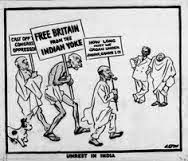
Conventional official history suggests that India rode to independence on a successful Quit India movement and which among others, is celebrated by the popular 1950s Abhi Bhattacharya film `Jagriti’ in a song “De di Azadi haemin bina kharag, bina dhal …’ (Gave us freedom without picking up a sword or  shield) . Popular perception and pieces of the jigsaw puzzle that is contemporary history, however gives less credence to the efficacy of the non-violent struggle of 1942 and more to the chain of mutinies which Netaji Subhash Chandra Bose and his INA initiated in giving the British the last push homewards.   
 In 1956 while on a trip to Calcutta, British Prime Minister Lord Attlee, who piloted the India Independence Bill into an Act in the British Parliament was asked by his host, the Acting Governor of West Bengal, Justice P.B.Chakravarti as to why the British decided to grant India independence within four year of having successfully crushed the Quit India civil disobedience movement of 1942 launched by Mahatma Gandhi.
The pipe-smoking, Labour leader Clement Attlee, known to be a plain-speaking politician who could be embarrassingly blunt, said that the most important reason was “the loyalty of the men of the (British) Indian Army to their British commanders had been undermined by Subhash Bose’s action.”
In his `The Journal’, French Nobel prize winning writer, Romain Rolland, says that Bose had revealed to him by the mid-1930s, that he believed the way to freedom was by harnessing the  “organised violence” of an armed force. This army, he believed should take the field when Britain herself was at war.
The Second World War gave Bose that grand chance. He took it with both hands. Most of us know the saga of his daring escape from house arrest in Calcutta and his travels in disguise through the North West Frontier and Afghanistan and on to Germany ; of his parleys with Hitler, his disappointment with Germany’s lack of material help or open declaration of support for India and decision to wage war against Soviet Russia. As well as the story of  his eventual arrival at Singapore after a daring submarine journey across two Oceans, to launch the rebel Indian National Army, a force of 55,000 soldiers drawn from Indian Prisoners of War and military age civilian volunteers from the Indian community in Malaya, Singapore and elsewhere in East Asia. A force free from religious or caste or linguistic divides, where officers and men and women (for the INA, far ahead of its times, had an all women regiment) alike were fired by one single goal – freedom of their motherland.
Netaji Subhash Bose with top INA officers, flanking him on the right is Col Lakhsmi Swaminathan
 
The INA along with the Imperial Japanese Army which was supporting it, lost the war in 1945. However, in defeat, their and their Netaji’s glorious saga of sacrifice managed to do something which no Indian leader had managed to do till then: stir the semi-literate villagers who made up the British Indian Army  and used by the British Monarch to rule over the sub-continent with a heavy hand, to  rise above all divisions in favour of India’s independence.  
As Colonel Hugh Toye, a British intelligence officer  charged with screening INA men after the war, wrote “In the eleven months which had lapsed since the first contact of the Indian Army, Navy and Air Force with the men of the INA in Rangoon, there had been wide-spread fraternisation. Its result was a political consciousness which the Indian serviceman had never before possessed.”
The result of this `consciousness’ or in the words of other classified British intelligence reports `contagion’,  was `alarming’. Colonel Prem Sehgal of the INA in his memoirs describes how after his capture at Alammyo, he was being driven to Magwe in a truck with an escort of two British NCOs, a Punjabi Muslim Naik and four sepoys of the Frontier Force Regiment. “On the way”, Sehgal said “the Naik got talking to me …. He told me that he was prepared to shoot the two British NCOs, after which he and his men would join me in escaping to the INA.”
Sehgal, who had been adjutant general of the INA, knew the war was over and wisely advised the Naik against this course of action. However, enthusiasm for the INA and its ideals of fighting for India’s freedom could not be stilled. At his jail in Magwe, the Colonel was again accosted by 20 soldiers of the Madras Regiment, “accompanied by the regimental clerk who spoke English. These men told me that they had come to meet me on behalf of their regiment and that their services were entirely at my command.”
Gurkha soldiers guarding INA’s Gen Shah Nawaz Khan sought an interview with their commanding officer and sought discharge to “join the INA” ! The most important work in turning the Indian soldiers around, was not done by captured INA men but really by Indian youth from Malaya and Singapore. They as pre-arranged, fraternized with British Indian Army soldiers and invited them home in batches to tell them the story of Netaji and INA. At times full length propaganda films shot earlier by the Azad Hind Government were shown to them.
In the chaotic Malaya of that time,  Netaji’s Indian Independence League and Bal Sena (Boy’s Force, akin to Boy Scouts or NCC) remained intact. They marched through the streets of towns and villages shouting :  `Jai Hind’, making quite an impact.  Several Anglo-Indian officers had joined the INA, including Col Cyril John Stracey who had built a Azad Hind war memorial consisting on Singapore’s beach front.  The British had it dynamited the moment they took back Singapore. However, the tens of thousands of Indians living on the island continued to throng the site everyday with flowers and to stand around recounting tales of bravery of the force. 
Azad Hind Government Currency
 In the meanwhile, Indian journalists including Amrit Lal Seth, Editor of Janambhoomi, were sent to South East Asia by the British Government as an extension of war propaganda to witness how the surrender  by Japanese was taking effect. However, they returned with a different tale altogether – that of a Shivaji like figure – Netaji Subhash Chandra Bose and his valiant band of INA soldiers.  This fired the imagination of India’s youth.
By November 1945, public demonstrations in support of  Netaji and the INA men who were being brought home as prisoners started. Lahore, Lucknow and Calcutta saw wide-spread demonstrations and rioting early in the month. In Calcutta, public unrest engulfed the largest city of the Indian sub-continent for 4 whole days, forcing the police to fire repeatedly. Pro-INA demonstrations spread to Delhi, Patna and Bombay.
In Calcutta, the situation was so dire that the European Association printed instructions for members on how to defend themselves and sought to build arsenals in towns and plantations.
A nervous Sir Henry Joseph Twynam, British Governor of Central Provinces, wrote to the Viceroy, Lord Wavell, on November 10, 1945 : “ When the air-born Division leaves Bilaspore, I shall be left without British troops … references to mutiny (by Indian troops) continue to be frequent.” In another letter to the Viceroy, Sir Henry reported : “At Jubbulpore, when a speaker … asked who would join the INA, all raised their hands.” (Jubbulpur did witness a short-lived Army rebellion in the following year)
By November 24, 1945, Field Marshall Sir Claude Auchinleck was warning the British Government of a full-scale rebellion in the offing. In an `Appreciation’, the Commander-in-Chief of the Indian Army wrote : “There are now large quantities of unlicensed arms throughout India and there will be many ex-INA men to use them … also  a considerable number of demobilized (British Indian Army) soldiers … principal danger areas are likely to be United Provinces, Bihar and Bengal, but trouble must also be expected in the Punjab, the Central provinces and Bombay.”
By February 1946, Royal Indian Navy ratings mutinied in Bombay. Many other ships followed. This was followed by mutinies by Air Force ground staff in several stations including Karachi. At some military stations, there were instances of NCOs and sepoys disobeying British officers or taking on an insolent attitude towards them, besides strikes by munitions workers.
A note entitled `Present State of Morale and Degree of Reliability of Indian Fighting Services’, prepared by the Director of Military Intelligence (DMI), said Signal Corps was unreliable as also other ancillary services. The entire navy and air force was of doubtful reliability! Of the main arms – infantry, armour, artillery and sappers, the note said they may be depended upon, with the caveat that this would depend on Indian Commissioned Officers remaining loyal, finally adding that it was difficult to assess these officers’ reliability!
Lt Gen S.K Sinha, then a captain at Army headquarters in Delhi later to become  Adjutant General of the Indian Army, many decades later wrote that he had managed to see the note marked `Top Secret - Not For Indian Eyes’ prepared by the DMI Maj Gen O’ Brien where the Emergency Commissioned Officers, who were the largest body of commissioned officers in the Indian army then, numbering nearly 12,000, were rated as `highly suspect’. Regular Indian Commissioned Officers numbering about 400, some of whom had joined the INA while others were believed bitter because of pay and social discrimination, were also rated as not to be fully trusted.
On the basis of this and other inputs, the Commander-in-Chief concluded in reports to the British cabinet that “most Indian officers are nationalists” and that should “the situation deteriorate … we cannot rely upon Indian armed forces, I may ask HMG to send as many British formations as can be made available.”
Field Marshall Auchinleck
 
Auchinleck believed that at least 5 more British divisions were required (than what was then available) to defend India in case of troubles. The issue was taken up by the British cabinet. However, what probably stopped His Majesty’s Government from again reforming disbanded regiments to police the Indian Empire was the war fatigue which had set in amongst ordinary British citizens after the six year long Second World War, which saw millions dead and tens of millions more made homeless or crippled for life.
The costs of continuing with the business of running the Empire would also be immensely huge even if the force was formed and sent. In the rebellion, which the British were sure was coming, hundreds of thousands of Britishers would surely die to keep Indians enslaved after having declared that they had fought the Axis powers to bring freedom and democracy to the world.
Gen Sinha wrote that the British were so nervous that they had even formulated an evacuation plan called `Gondola’ to ensure timely evacuation of some 43,000 Europeans in case of a full scale rebellion, with maps showing evacuation routes to port cities.
It was then that the British came up with their ingenuous plan of a three tier constitution, which eventually evolved into a plan to carve up India, before the British left.
This by itself is not a historical analysis which can openly conclude that the last push to send the British out of India was given by Netaji and his INA. However, in conclusion, I would like to relate the second half of the interview between Lord Attlee and West Bengal’s Acting Governor and leave the reader to make his own judgement. In a letter to noted historian Ramesh Chandra Majumder, Justice Chakravarti, describing the interview with Lord Attlee, said “towards the end of the discussion, I wanted to know to what extent Mahatma Gandhi’s non-violent movement had influenced the British decision to leave India. There was a flicker of a smile on Attlee’s lips as he uttered with slow deliberation the word “mi-ni-mal”.  


Tuesday, December 23, 2014

Oil Magic


Many say that it is not Modi magic which has saved the Indian economy from going Europe’s way but rather oil magic. Prices of India’s biggest import item – crude oil – fell by some 46 per cent from a peak of $ 107 in June to less than $ 57 a barrel by last week of December.

India's oil import bill for the last financial year stood at $150 billion. A $ 30-40 billion cut in that huge bill translates into that large a stimulus for the Indian economy. A rough back of the envelope calculation says that every $ 25 cut in crude prices translates into a $ 10 billion stimulus for the Indian economy.

The impact is visible -  the rupee value is far more stable, the fiscal deficit despite being worrying is more manageable because the Government spends that much less on fuel subsidies and has more money to spend on infrastructure. Finance Ministry economists estimate that instead of last year’s Rs 140,000 crore oil subsidy bill, the actual bill this year is likely to be nearer Rs 80,000 crore.

Banks have more money to lend as Government borrows less to pay for its oil bill (estimates are that the Government borrowed $ 39.25 billion less in the first half of this year than what it had planned to), which translates into more lending and more consumer demand.

Indian consumers too benefit, as prices linked to fuel – energy, food and vegetables – either fall or at least remain stable. Less spending on petrol  and diesel to run busses, trucks, cars or two wheelers also means that much more money in hand with ordinary citizens for other necessities.

Of course, the full impact of the drop in crude prices has not been passed on by the Government. A two-step rise in excise duty has ensured that the Government will mop up an extra Rs 40,000 crore in taxes and deny consumers that much money in hand. However, the Government has been beset by falling revenue collections and its excuse that this was the only way it could balance its books, seems to have been accepted by a wary citizenry.

This move to `balance books' of course is a leaf taken out of the thinking from the old `Command and Control’ economy which the Narendra Modi Government says it intends to do away with. True adherence to market economics would have meant passing on the drop in oil prices in full, to consumers and giving them the right to give the market a stimulus through increased consumer spending. But then, like all other things Indian, to expect us to make the leap from a `planned economy’ to a market economy with one change in Government is to expect too much. Change here really means change with  continuity ! 

The obvious question rising from all this is how did this change in our fortunes  happen? Crude prices are really down because of discoveries of shale oil in the US and Canada. There has been an increase of 1 million barrels per day of oil available in the market for each of the last three years because of the US shale revolution. Not only has more oil has come into the market, but the US, traditionally the largest importer of crude, no longer needs Saudi oil to fuel its engines !

The Saudi Arabia-led OPEC (Organisation of the Petroleum Exporting Countries) has traditionally tried to hold prices by cutting supplies. However, this time around, fears that US and Canada, will not cut oil supplies to the global market and muscle into their traditional markets stayed their hand. Possibly the fact that the oil countries which have traditionally used their oil wealth to build infrastructure and subsidise citizens’ lives are under greater pressure to continue to do so to keep them loyal in the face of a fundamentalist Islamic  revival in Arab lands which threatens the oil monarchies.

In fact conspiracy theorists claim that the US is intentionally driving down prices to beggar enemies and frenemies (friends who are really its rivals) ! Kuwait, Qatar and the United Arab Emirates can break-even on their budgets with oil priced at about $70 a barrel. Whereas, Iran needs a price of $136, Venezuela and Nigeria - $120 and Russia - a price of  $101 – making these economies vulnerable whenever the crude price plunges.

Postscript: Is oil below $ 60 the end of the story? Experts expect the fall to continue to sub-$50 levels and that to help economies like India and the US become productive and healthier. `Maybe `acche din’ may not be too far now !

Thursday, December 11, 2014

Mumbai Home For `A Girls Best Friend'

Diamonds - they say - is a Girl's best friend

Egged on by a Russia smarting under European sanctions, India wants to leverage long term buys of rough diamonds worth billions of dollars from the world’s biggest diamond miners -  Alrosa of Russia – to help turn Mumbai into a rival diamond trading hub to Belgium’s Antwerp.
Prime Minister Narendra Modi has announced that his government has decided to create a special notified zone, to which mining companies can import rough diamonds on a consignment basis and re-export unsold ones. The move, Indian diamtaires said could help turn India's financial capital into Asia's diamond trading bourse.
The Modi announcement came at a joint innauguration of a world diamond conference here with Russian president Vladimir Putin, whose Government owns 44 per cent stake in Alrosa, the mining giant which accounts for 30 per cent of the world’s annual yield of rough diamonds. About half  of its output is now sold to India through diamond bourses in Antwerp and Dubai, a fact which both Russia and India want to change by doing business directly.
“We get better margins and have stabler production regimes  if we can get into long term purchase agreements with Indian diamantaires… we used to have three such deals 4 years back, now this year we are increasing it to 12,” said Andrey Polyakov, vice president of the $ 5 billion mining giant which has since long overshadowed the more famous DeBeers in the diamond market.

Rough Diamonds - India Processes 70 % of Global Production

"We (Indian firms) will be buying diamonds worth $2.1 billion from Alrosa in the next three years," Gems and Jewellery Export Promotion Council Chairman Vipul Shah confirmed.
India sees this as a big opportunity to be grabbed to turn Mumbai into a rival to Antwerp and Dubai. “We are talking to the Government to give us a tax regime for diamond traders similar to Antwerp which has a small presumptive tax on trading profits and allows miners to bring sparklers here, sell whatever they can and take back unsold stones without taxes and hassles,” said Pankaj Parekh, vice chairman of the Gems & Jewelery Export promotion Council.
Russia is not averse to this as US and European sanctions means that it may not be able to sell directly in Antwerp, the largest market for diamonds in the world, and may have to resort to the Cold War period subterfuge of selling its diamonds through DeBeers or some other diamond miner.

The Modi-Putin Diplomatic Tango

At the `World Diamond Conference' here, the `Big Boys’ of the global diamond market – Alrosa, DeBeers, Rio Tinto came to mingle with India’s diamantaires. India already processes some 70 per cent of the world’s diamond roughs into polished diamonds or sets them into jewellery to be sold all over the world.
Forecasts by diamond miners’ associations say that the market for retail or finished diamonds in India and China is rising and taken together could equal that of the US, currently the world’s largest market within the next 6-7 years.
Alrosa’s interest in striking direct deals with Indian firms is but natural says Parekh. Polyakov avers : “We follow the trade.”
Parekh and other GJEPC office bearers have been doing the rounds of North Block and global mining capitals to try get their dreams of Mumbai rivalling Antwerp as a trading centre off the grounds. “Does Mumbai have the potential to be a diamond hub?,” asks Polyakov rhetorically. “I think the answer is – yes – you just need to follow rules  that other hubs do.”
There is of course more than `following the trade’ or `potential’ involved here. Russia is perhaps trying to make a statement to both India and the West. Russian analysts in recent weeks have been at pains to stress that sales of helicopters to Pakistan does not mean that the `special relations’ with India are to be endangered and the high profile visit along with help in transforming Mumbai into a diamond trading hub along with key defence, gas and nuclear deals are expected to be part of that statement.

Mumbai- the New Diamond Capital?

Thumbing Russia's nose at western sanctions is of course something which Putin has been working at for quite some time with gas deals with China and East European nations.  A diamond deal with India could well help him teach the European Union with which Russia is locked in a conflict over Ukraine, that in the resources market, it still counts.
 

Monday, August 11, 2014

Should We Celebrate World War I ?


Comic strip on the war
The War to end all Wars  - That is how leaders of that era sold the war to people at large !  It did not of course, end all wars. Not even in Europe where it was largely fought. 

This is a year when many people around the globe are celebrating the memory of that war. However, as nations pay homage and hold grand ceremonies to commemorate the `Great War' and the generation which fought it, many forget the reasons why the war  was fought in the first place.

Was it about naval rivalry? National Pride? Naked German aggression ? The inherent conflict between European royalty, all of whom were closely related to each other, triggered by the assassination of one of them in distant Sarajevo ?

All these were certainly factors, but the underlying reason for most wars are economic. The First World War too was no different. The war in truth, was a conflict over the spoils of colonialism.

The first world war was preceded by a mad scramble  to occupy Africa. All European powers joined in the race to claim bits and pieces of the `Dark Continent' with its immense riches. The major European powers had already carved up the Americas and much of Asia in the centuries before and in the process increased the per capita income of their citizens manifold. This was the last habitable bit of Earth which could be had to add to Imperial `estates.' In this battle for land and influence, as first movers, France and Great Britain, had an advantage over late comers like Germany and Austria and that triggered the tensions which transformed into a World War. 

The rivalry between the two camps – newly arrived Germany and land-locked Austria-Hungary  on the one hand and older sea-borne colonial powers – was not just for colonies, but also colonial trade, trade routes and privileges.

An insight into the scramble for colonies can be had from the two Moroccan crisis which occurred  just before the Great War began –
In 1904, France had concluded a secret treaty with Spain partitioning Morocco and agreeing not to oppose Britain’s moves in Egypt in exchange for a free hand in the till then independent kingdom of Morocco.  The next year, German emperor Wilhelm II visited Tangier and declared for Morocco’s independence, not really in support of an oppressed people, but because he wanted to parley with fellow European kings over colonial rights and needed a bargaining chip.

This `First Moroccan Crisis’, was resolved in January–April 1906 at the Algeciras Conference, where German economic rights in the region were upheld, while the French and Spanish were entrusted with the policing of Morocco.
The World Carved Up Among European Powers

The Second Moroccan Crisis sparked in 1911,  when the German gunboat Panther was sent to Agadir  ostensibly to protect German interests during a local uprising in Morocco but in reality to cow the French. This “Agadir Incident” sparked a flurry of war talk during that year, but international negotiations continued, and the crisis averted with the conclusion of a convention in November 1911, by which France became `protector' of Morocco and, in return, Germany was given strips of territory from the French Congo. Obviously, the local people were never consulted when they were bought or sold!
Map of the proposed railway

However, the Germans had ambitions further afield, which included nebulous control over the newly found oil wealth of Mesopotamia. A Berlin-Baghdad railway line was planned which could be later extended to Teheran. Germany would be supplied by oil and other supplies from the east, by this railway, while the Ottoman Empire which controlled Baghdad would gain a railway network for quick military mobilization into the Balkans were they were facing up to Russia's expansionist threats. The problem was that a German railway up to Baghdad or Persia, was just a step away from India !

Let me quote the American Orientalist Morris Jastrow, to explain what was at stake : "It was felt in England that if, as Napoleon is said to have remarked, Antwerp in the hands of a great continental power was a pistol leveled at the English coast, Baghdad and the Persian Gulf in the hands of Germany (or any other strong power) would be a 42-centimetre gun pointed at (England's dominion over) India."

Europe readied for war. The older colonial powers – France, England, Russia and Italy to protect their colonies and trading privileges, the newer ones – Germany and Austria, hand in glove with a  threatened tottering power – the Turkish Ottomans, in search of fresh colonies and trade routes. The assassination of Archduke Ferdinand  of Austria at Sarajevo by Serbian-Bosnian rebels in 1914, was merely an excuse for the war to begin.

We, Indians, had no say in the war at all. Most Indians wanted only one thing - independence. Not rule by  King George V or by Emperor Wilhelm II. However, without any strong national leadership, Indians joined in the war effort in large numbers for the pay and job opportunity which came their way.  Boys from rural India fought bravely and possibly won the larger part of the war in the Middle East. Damascus, Palestine, Jerusalem, Gaza, Haifa, Kut-Al_Amara, Baghdad, Basra and Tigris, all figure in the battle honours list of the Indian Army. (Lawrence of Arabia and his motley crew of supporting Sheikhs, were considered by many as merely extras in that battle for Arab lands. The real muscle power was mostly Indian.) More than half of the Indian brigade thrown at Gallipoli died in a brave but futile attempt to take on Turkey's brilliant General, Kemal Pasha, side by side with the ANZAC (Australia and New Zealand) troops, though in the national memories of the West, that epic folly of a battle is associated with Australians alone. In all some 65,000 Indian soldiers died fighting the King's war. The Sub-continentals won some 13,000 gallantry medals including 12 Victoria Crosses, the highest gallantry award the British gave to a fighting man.
Recruitment Poster

Quite rightly, we need to celebrate our boys' bravery and mourn those who died. However, should we really celebrate this war which was not ours ? There is after all a distinction to be made in celebrating our own people’s bravery and someone else’s victory.

Neither was the victory ours nor the defeat. It was a white man's war fought also by brown and black boys, who were not allowed to be promoted to officer ranks nor get the same pay or perks that their white brethren received. The 140,000 Indian soldiers rushed to defend France were sent in without adequate winter clothing or footwear ! Despite that they fought and were decisive in the battles of -Ypres, Givenchy, Neuve Chaplle, Festubert and Loos.  Modern medi-care was given to the Indian wounded, but in segregated hospitals on the English coast. Barbed wire surrounded these hospitals and sepoys were not allowed into town un-chaperoned ! Even in matters of food they were discriminated.


An Indian soldier’s daily ration during the Great War consisted of :


14 pounds (lb) meat
(Non-meat eaters received 2 ounces of gur (coarse, unrefined sugar made from sugar cane juice) or sugar or 3 ounce (oz) of milk in place of 4 ounces of meat); 18 lb potatoes; 13 oz tea; 12 oz salt; 1 12 lb atta (raw flour); 4 oz dhal (dried lentils or peas or beans); 2 oz ghee (clarified butter); 16 oz chillies; 16 oz turmeric; 13 oz ginger; 16 oz garlic and 1 oz gur (unrefined sugar)
While  a British soldier received :

1 & 1/4 lb fresh or frozen meat, or 1 lb preserved or salt meat
1 & 1/4 lb bread ; 4 oz. bacon; 3 oz. cheese
5/8 oz. tea; 4 oz. jam ; 3 oz. sugar ; 1/2 oz salt ; 1/36 oz. pepper
1/20 oz. mustard ; 8 oz. fresh or 2 oz. dried vegetables ; 1/10 gill lime juice (if fresh vegetables not issued);
1/2 gill rum (at discretion of commanding general) ; up to 2 oz. tobacco per week (at discretion of commanding general)

Britain is right in celebrating the first World War. It was  indeed her hour of glory. Britain is also right in apportioning some credit (belatedly?) to the 1.4 million Indians who donned the colours to fight for Britain.

This leads me to the logical question, could we  in any way be described as part of the victors' party? I would not hesitate to say `No'. Please remember Indians were not even allowed to enter certain streets and clubs inside India at that time or aspire to most of the higher ranks of service within their own motherland. India's revenues were being used to finance British colonial wars in all parts of the world - ranging from China to Africa and even to the European theatre, without our  agreement, and by beggaring our people in the process. During World War I, Britain stripped India of 3.7 million tonnes of supplies worth 80 million pounds and 146 million pounds of revenues for the war effort, the largest contribution by any country's colony.  To understand the value of that contribution at today's rate multiply the figures by 340 and that gives you the mind-boggling figure of  76.84 billion pounds or Rs 783,760 crore. This happened even as teenagers were being jailed for reciting `Vande Mataram' and hung for fighting for India's freedom. 

Landmarks in our nation's history - the Komagata Maru  incident - happened in May 1914, while - the Jalianwala Bagh massacre - happened in 1919.   Should we not commemorate those sad milestones in India's freedom struggle from Britain, rather than applaud a victory in an European war, which merely deprived us ?

Postscript:
India's First Flying Ace : Indra Lal Roy
First Day Cover to Commemorate India's first flying ace


Indra Lal Roy, India's first ace pilot, was born in Calcutta on 2 December 1898. Despite initial prejudices against him, Roy, a schoolboy at St Paul’s, London,  managed to win a commission in the Royal Flying Corps in 1917, at the young age of 18, within three months of joining the Corps. Credited with 10 kills including 9 in a span of just 14 days over the skies of France, he died a hero in 1918, to be  posthumously awarded the Distinguished Flying Cross.


The citation in the London Gazette on 21 September 1918 praised Roy as 'a very gallant and determined officer' whose 'remarkable skill and daring' had enabled him on occasion to shoot down 'two [enemy] machines in one patrol'.
------------------------------------------------------------------------------------------------------------------------

Tuesday, January 14, 2014

India's Iron Ore and China's Growth


India may well reconsider an option it rejected exactly ten years ago - Banning export of iron ore unless it’s converted into a value added metal. A move which Indonesia has endorsed over the weekend, forcing global miners to announce plans to set up refineries in the mineral rich but heavy industry-poor  South East Asian economic powerhouse.  
Top officials in the steel ministry and planning commission who had a decade back argued that allowing Bellary-Hospet’s mineral riches to be exported to China without any value addition, meant losing out on job creation at home besides reducing export incomes which could come when ore is refined into costlier iron pellets or steel, had their ` Vous a dit si’ or `I told you so’ moment.
Top officials who said they would study Indonesia’s move to see how President Susilo B Yudhoyono’s move helps grow investment and export valuations, had ten years back opposed removing a cap on sale of high grade iron ore lumps and fines from Bellary-Hospet and Bailadilla mines. They had, instead, presented the then NDA Government with an alternate note which proposed encouraging those who wish to import ore from India to set up iron pellet making or steel-making capacity here.
Officials had also argued that ore exports, to China, if allowed, should be linked to barter deals for high grade coal from that nation as India was projected to spend huge amounts on import of in future years. Neither of these arguments were paid much heed to, instead the cap was lifted. The result : 1) India 's export of iron ore, sold at a tenth of the price of steel, zoomed by a 100 per cent in just 3 years to 100 million tonnes; 2)  By 2012-2013, India was spending $ 18 billion in importing 137 million tonnes of coal compared to a couple of million dollars, ten years back.

After the Congress-led UPA government took over a rethink on the old policy started. However, once again the mining lobby won the day and ultimately, the government continued with its policy of allowing ores to be exported. Rules said only fines and lumps with low grade iron would be allowed to be exported. However, the reality which later Supreme Court appointed committees exposed was that high grade iron ore kept being shipped out of the country, with 80 per cent of it headed towards China. 
China’s steel-making capacity based on iron ore imports from India, Indonesian, Australia and Brazil, doubled to 800 million tonnes a year in these 10 years. Imports from India and Brazil were especially prized as these were of high grade ore with iron content of near or above 60 per cent.
In sharp contrast, India's steel making capacity increased from 48 million tonnes in 2004 to around 78 million tonnes in 2014, a fraction of the amount of steel churned out by China, a nation with very poor iron ore resources.
Needless to say economists have long been able to trace a direct correlation to steel production and usage to a country's per capita income growth.

When current Himachal Pradesh chief minister Vir Bhadra Singh, took over as steel minister in 2009, he renewed the battle arguing in notes that India is a  “major producer of iron ore, much of which we export at low price  ... we should rather work towards a policy of encouraging value added exports which fetch us better revenues."
This was reiterated again last year by steel minister Beni Prasad Verma who argued that it "makes more sense to push exports of steel valued at $ 800-1000 per tonne rather than raw materials valued at $100-120 per tonne.”
Ultimately, it was the courts which stepped in to stall ore exports, but not on policy considerations but rather to stop rampant, illegal mining which could degrade the environment.  The result, point out steel ministry officials, has been rather good for value-added iron pellet exports. While iron ore shipments declined drastically with total ore exports likely to be less than 30 million tonnes this financial year, compared to 62 million tonnes in 2011-2012. Iron pellet exports witnessed a boom,  with most of it headed towards China. Exports of pellets which are the costlier replacement for ore in steel making, are likely to be nearly 800,000 tonnes in this financial year or 20 times exports in the previous 2012-2013 year.

Thursday, December 5, 2013

Bali & Feeding The Poor


US Trade Representative Michael Froman famously told his colleagues at Bali  : “Let us not sugar coat reality: Leaving Bali this week without an agreement would deal a debilitating blow to the WTO.”

Mr Froman, is of course right in saying so. The absence of a `deal’ at Bali will hurt global commerce. And who knows that better than third world trade ministers, all of whom are praying for a resurgence in trade and global economic well-being, to help boost their battered currencies and slowing economies.

However, if one were to rephrase what Froman said, in the Indian context, one would have said: “Let us not sugar coat reality: Leaving Bali without guarantees that one sixth of humanity are able to eat two square meals because of some outdated rules that the Western world wants to stick to, would deal a debilitating blow to humanity at large … it will prolong the hunger, malnutrition and suffering of India’s and the developing world’s poor for many, many more years.”

Commerce and Industry Minister Anand Sharma knew that while he may be blamed for being a deal-breaker or a deal-jeopardiser for his stand that food security measures be exempted from WTO interventions, failure to protect the interests of a billions of poor people to have food security would have history judge him far more harshly.

Frankly, I believe it is not only just, but also makes immense business sense to support a food security bill will help bring affordable food to the tables of hundreds of millions of India’s poor.   

First, let us examine what is it that India wants. Then, try and understand how this actually makes good business sense for the whole world.

India wants the right to buy and stock large quantities of foodgrain for distribution at cheap prices to its poor. The amount involved is of course huge – some 62 million tones of foodgrain to be sold to some 820 million people at last reckoning.  

Feeding India's Poor
The subsidy involved could breach the limits set by WTO for governmental subsidy for the farm sector because the global trade body insists on calculating the price of this food at an artificial price based on lower global prices set in the 1986-87 era. Since then, global and Indian food prices have gone up several-fold.

The western powers are willing to allow an exemption to this rule,  but for just four years, even as they funnel far larger sums as subsidy to their own farmers. The US pays about $ 20 billion in subsidies to its farmers annually every year, while the EU mandated a Euro 57 billion subsidy package for its farmers! In contrast Indian food subsidy bill for whole year will come to about a third of what the EU spent in 2010.   

Also worrisome from the Indian point of view is that clauses in the WTO rulebook, leaves even this exemption open to challenges before the body’s arbitration authority, in case any member feels it distorts global trade.


Obviously anything that India does can distort world trade. After all we are talking about food grown and consumed by a sixth of humanity. In years, India stopped rice exports there were famines and riots in Africa. India and the Chinese are the proverbial `Elephants in the room’ and everybody knows that. However, that does not mean India should not be allowed the right to feed its poor.

Now, let’s see why feeding India’s poor could be good for global business. By reducing the cost of food for 820 million people, the government will be increasing disposable consumption expenditure in the hands of these people, most of whom live in India’s villages. That, would surely boost rural demand already on an upswing, hugely.

According to NSSO data, between 2005 and 2010, the number of people living below the poverty line in rural areas has dropped to 21.72 crore from 32.58 crore. According to some studies, rural GDP is growing 16 per cent.

I wonder if any of those trade ministers sitting in Bali have tried to imagine what will happen if India’s rural demand booms. Demand for manufactured goods could again hit double digits, leading to expansion of existing factories, and setting up of new ones to feed that demand. The boom in jobs and services to feed that growth would throw up fresh demand. A virtuous cycle of demand and growth to feed that demand would be created.

Double digit or near double digit growth in an economy which is already valued at near $ 2 trillion, would mean unleashing huge demand for goods and services produced all over the world. In short, allowing India to feed its poor millions could well mean a way out of the economic morass, the world has sunk into.