Its official now.
Chief Economic Advisor Raghuram Rajan will be the next Governor of the Reserve
Bank of India after the current Governor D Subbarao retires in September.
 |
| Raghuram Rajan |
"Prime Minister
has approved the appointment of Dr. Raghuram Rajan as the Governor of Reserve
Bank of India (RBI) for a term of three years, vice Dr. D. Subba Rao upon
completion of his (Dr. Rao's) tenure …" the bland statement said.
However what it
left unsaid was the great amount of politiciking which went on behind the
scenes before 50-year-old Rajan was given the job of heading India's central bank at a time when GDP has slowed down to 5 per cent from an average of 8-9 per cent through the last decade, inflation remained high at nearly 5 per cent and the Rupee value against the dollar has come down by some 12 per cent in just over a month.
In the last few weeks, Rajan who has
earlier served as chief economist with the World Bank and taught at University
of Chicago's Booth School of Business, was locked in a race with
Arvind Mayaram, secretary in the finance ministry for the job after Subbarao
told finance minister P Chidambaram that he was not keen on another term.
Subbarao who may have
said otherwise, had little choice but to move on as signals coming out of New Delhi made it quite clear
that he may not be the man the UPA Government wants at this crucial stage.
Finance Ministry
insiders say that Rajan, was always the favourite for the slot, with
Chidambaram himself backing him for the job. While prime
minister Manmohan Singh, who himself had been an RBI Governor, too
preferring giving an economist a shot at the job at this crucial juncture.
 |
| D Subbarao |
The powerful Indian
Administrative Service (India's civil service's upper echelon) lobby was however seen backing Mayaram for the job as it
was possibly keen that the country’s top money manager’s job remained with it. Subbarao
too had been an IAS officer as had been his predecessor Y.V.Reddy.
Rajan does not
really have much administrative experience but is considered one of the
brighter young economists having earlier forecast the coming global financial
crisis in a lecture made to the world's central bankers at their annual retreat
in Jackson Hole, Wyoming, USA in August 2005. Not something which the central
bankers exactly appreciated at that time.
Writing later in
his bestseller `Fault Lines: How Hidden Fractures Still Threaten the World Economy’,
Rajan described the situation as :
"I exaggerate only a bit when I say I felt like an early Christian
who had wandered into a convention of half-starved lions."
 |
His colleagues at
North Block said that might exactly be how he might feel when he goes to run
one of the most complex and powerful central banks of the world from next month
on as he has at many times been arguing exactly the opposite of what the RBI
has been doing, especially on cutting interest rates.
North Block and
Subbarao had not seen eye to eye for quite a long time with Subbarao refusing
to toe the finance ministry line that economic growth should be the top
priority by arguing that inflation remained his primary concern and delaying
cutting high policy interest rates or by reducing interest rates in small driblets of 0.25 per cent.
The problem,
officials claimed was that Subbarao who has earlier served as finance secretary
felt the finance ministry had no business telling him what to do as he knew
both the jobs, while the UPA government felt the RBI Governor did not
understand the political imperatives of creating new jobs and raising growth
rates in a pre-election year.
While the tension
between the Ministry and RBI had remained contained during President Pranab Mukherjee’s
tenure as finance minister, it was in the words of one North block top honcho
“quite palpable”, after Chidambaram took over.
Both the RBI and
the government knew that a foreign exchange cloud was on the horizon as early
as the beginning of this calendar year. Indian companies have to pay back $ 170
billion in short term debt by March-end 2014, while its forex reserves are
just about $ 280 billion. However both seemed to be crossing out the others’
suggested solutions to the problem. When the government which has always been conservative
over sovereign bonds thought about it, the RBI opposed it openly. The RBI on
its part delayed taking steps to tighten controls over foreign exchange
markets which could have reduced speculation on the rupee.
 |
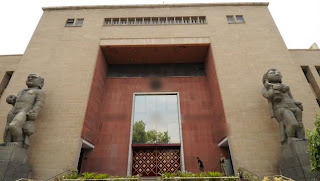
| The Iconic RBI Building at New Delhi |
Rajan after getting the news that he was the chosen man for the big job, said
he has “no magic wand” to solve the slowdown but advocated close coordination
between the government and RBI in handling the ongoing crisis which has seen
the rupee slip to below Rs 61 to the dollar levels frequently and Jan-March
2013 GDP growth slipping to 4.8 per cent. This `co-ordinated' approach was something which the Government and markets wanted to hear. The Indian Rupee recovered shortly after his appointment was announced.
At least one
thing is assured, say colleagues, Rajan will act. "The cost of doing
nothing," the economist had written in his seminal book `Fault Lines’ on
the global financial crisis and its causes, "is perhaps worse turmoil than
what we have experienced recently" because "unchecked, the fault
lines will only deepen."